
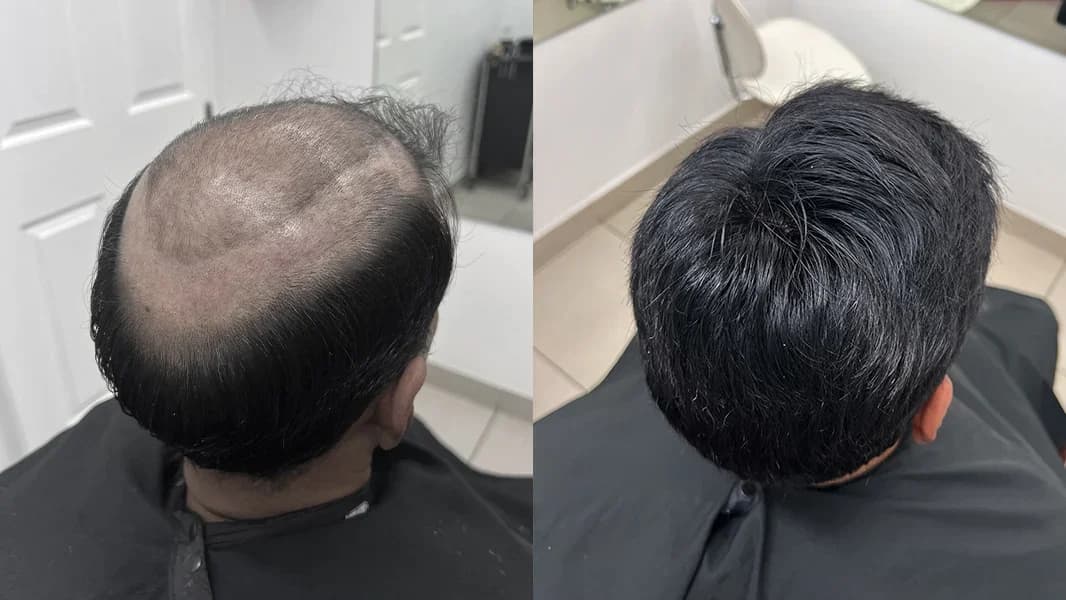
Around half of Australian men experience noticeable hair loss by 50, and many start seeing it in their 20s. Understanding what's happening - and what can genuinely be done about it - helps you make a calm, informed decision instead of a panicked one. Here's the full picture.
Why male pattern baldness happens
Androgenetic alopecia is driven by a combination of genetics and dihydrotestosterone (DHT), a hormone that progressively miniaturises genetically susceptible hair follicles on the top of the scalp. The follicles on the back and sides are typically resistant, which is why hair loss follows the familiar pattern of a receding hairline and thinning crown.
It's progressive: without intervention, miniaturised follicles eventually stop producing visible hair. That progression is also why any solution needs to account for future loss, not just today's.
Option 1: Medication
Finasteride (prescription) blocks DHT and can slow or stop progression for many men; minoxidil (over the counter) can stimulate some regrowth. Both work best early, require indefinite use, and results vary widely. Some men experience side effects. Medication maintains - it rarely restores significant density.
Option 2: Scalp micropigmentation (SMP)
SMP tattoos tiny dots on the scalp to mimic a shaved head or add the illusion of density to thinning hair. It's effective for men happy with a buzzed look, and increasingly used alongside hair systems to create a denser-looking hairline. It doesn't create actual hair.
Option 3: Hair transplant surgery
Transplants relocate follicles from the back of your head to thinning areas. When you're a good candidate - early loss, strong donor supply - results can be good, though they take 12–18 months and cost $10,000–$30,000+. Density is limited by donor supply, and ongoing natural loss often requires further procedures.
Option 4: Non-surgical hair systems
A custom hair system restores a completely full head of hair immediately, regardless of how advanced your loss is. Modern systems are undetectable, secure through sport and swimming, and cost a fraction of surgery. The trade-off is ongoing maintenance every 3–5 weeks and system replacement every 6–12 months.
For men with moderate to advanced loss who want real density - not a compromise - it's the only option that guarantees the visual result.
Making your decision
The right choice depends on your stage of loss, budget, timeline and how much density matters to you. If you'd like an honest, no-pressure assessment - including being told if a hair system isn't right for you - book a free confidential chat with our team.